
Best GPU for AI on a Budget? Intel’s Arc B50 Delivers Big Performance for $349
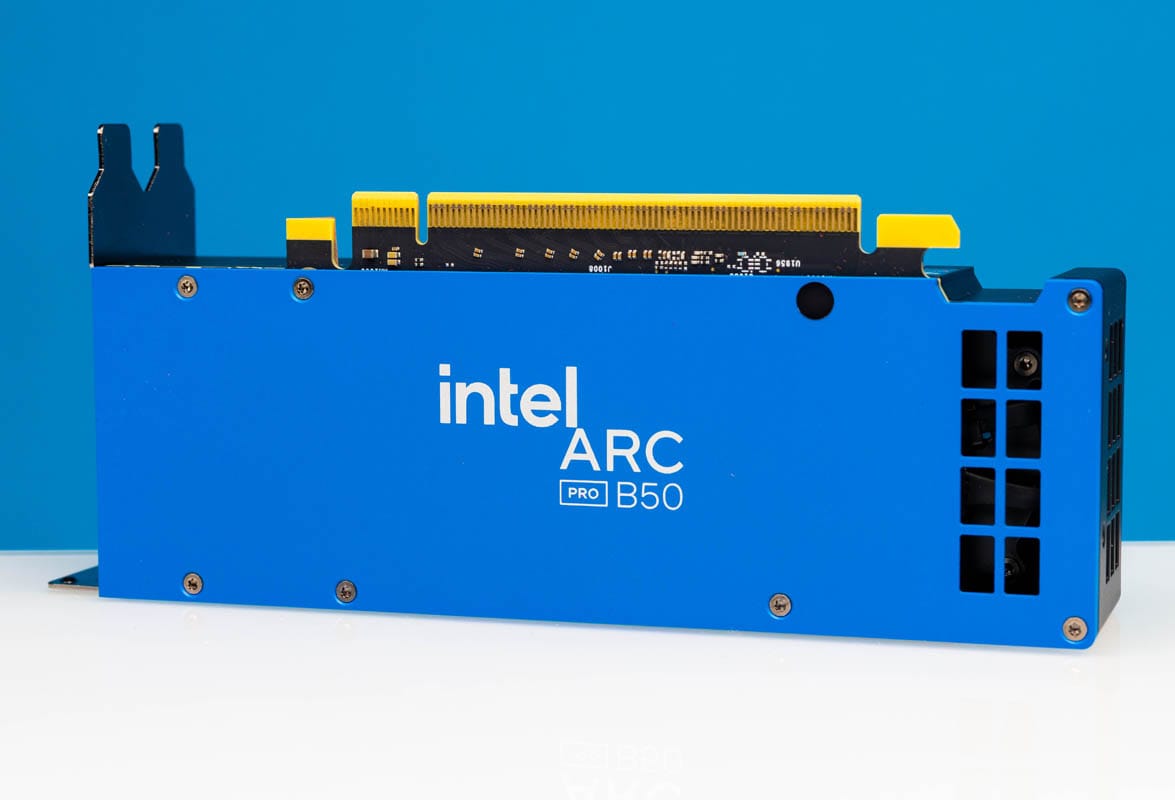
Would you believe this tiny blue-accented card is a GPU? At first glance, the new Intel Arc Pro B50 looks almost too small to be taken seriously—but don’t let its size fool you. This compact powerhouse is shaking up the entry-level workstation GPU market in a big way.
Intel just released this new Gen 5 PCIe card as the successor to the A50, but it’s not just a simple refresh. The “Pro” in its name means it’s designed not for gaming (though it can handle that just fine), but for professional workstations, home servers, and machine learning tasks.
And that’s where things get interesting.
Small card, big capability
Inside this little card lives a surprising 16 GB of VRAM—something that’s practically unheard of at this size and price point. For context, most GPUs in this range barely crack 8 GB. Intel really went all in here, giving professionals and AI enthusiasts a serious memory advantage without breaking the bank.
The Arc B50 was announced at $299, and even after a small bump to $349, it’s still the cheapest 16 GB GPU you can buy right now. For comparison:
- NVIDIA’s RTX A1000 (its direct competitor) has only 8 GB of VRAM and costs around $426.
- The step-up A2000, which does have 16 GB, will set you back between $700 and $800.
In other words, you’re getting a lot bang for your buck.
Efficient, compact, and cable-free
The B50 is refreshingly simple to set up. Just slot it into your motherboard and you’re done. There are no extra power cables, no bulky connectors, and no special cooling setup. The entire card draws just 70 watts from the PCIe slot—ideal for compact builds or energy-efficient workstations.
That also makes it perfect for home servers or small form factor AI rigs, where power efficiency and space are key.
Built for work, not just play
While gamers might dismiss it as “the baby GPU,” the B50 isn’t trying to be a high-end gaming card. It’s built for machine learning, data processing, and professional graphics workloads.
In early testing with tools like LM Studio, the card performed impressively:
- It ran 4B and 20B parameter models smoothly.
- It handled up to 12–13 GB of VRAM usage while leaving headroom for longer context lengths.
- Using Vulkan drivers, performance stayed steady around 35–50 tokens per second, depending on the model and prompt complexity.
That’s strong performance for a GPU that doesn’t even need auxiliary power.
Taking on the competition
Intel has positioned the Arc B50 directly against NVIDIA’s A1000—and it’s not a subtle comparison. Intel’s own data shows the B50 delivering better performance and higher value across both graphics and inference workloads.
Given that the A1000 costs more, delivers less, and offers half the memory, the value proposition is clear. Even AMD’s comparable workstation GPUs struggle to match this kind of price-to-performance ratio in the low-power category.
Who it’s for
- AI developers running local models
- Creative professionals who need affordable GPU acceleration
- Home server builders seeking low power draw
- Small studios doing light 3D rendering or media processing
At just 70 watts, the Arc B50 can go where bulkier GPUs simply can’t—making it a smart choice for compact builds and quiet workstations.
The bottom line
The Intel Arc B50 is a small card with serious professional ambitions. It’s not trying to dethrone the gaming heavyweights, but instead carving out its own space—offering large memory, workstation reliability, and AI-friendly performance at a price that’s hard to ignore.
If you’ve wanted to experiment with local AI models, upgrade your workstation GPU, or build a capable server on a budget, the Arc B50 deserves a spot on your shortlist.
Intel’s message is clear: affordable doesn’t have to mean underpowered.
Also check out Alex Ziskinds video about it here:


